
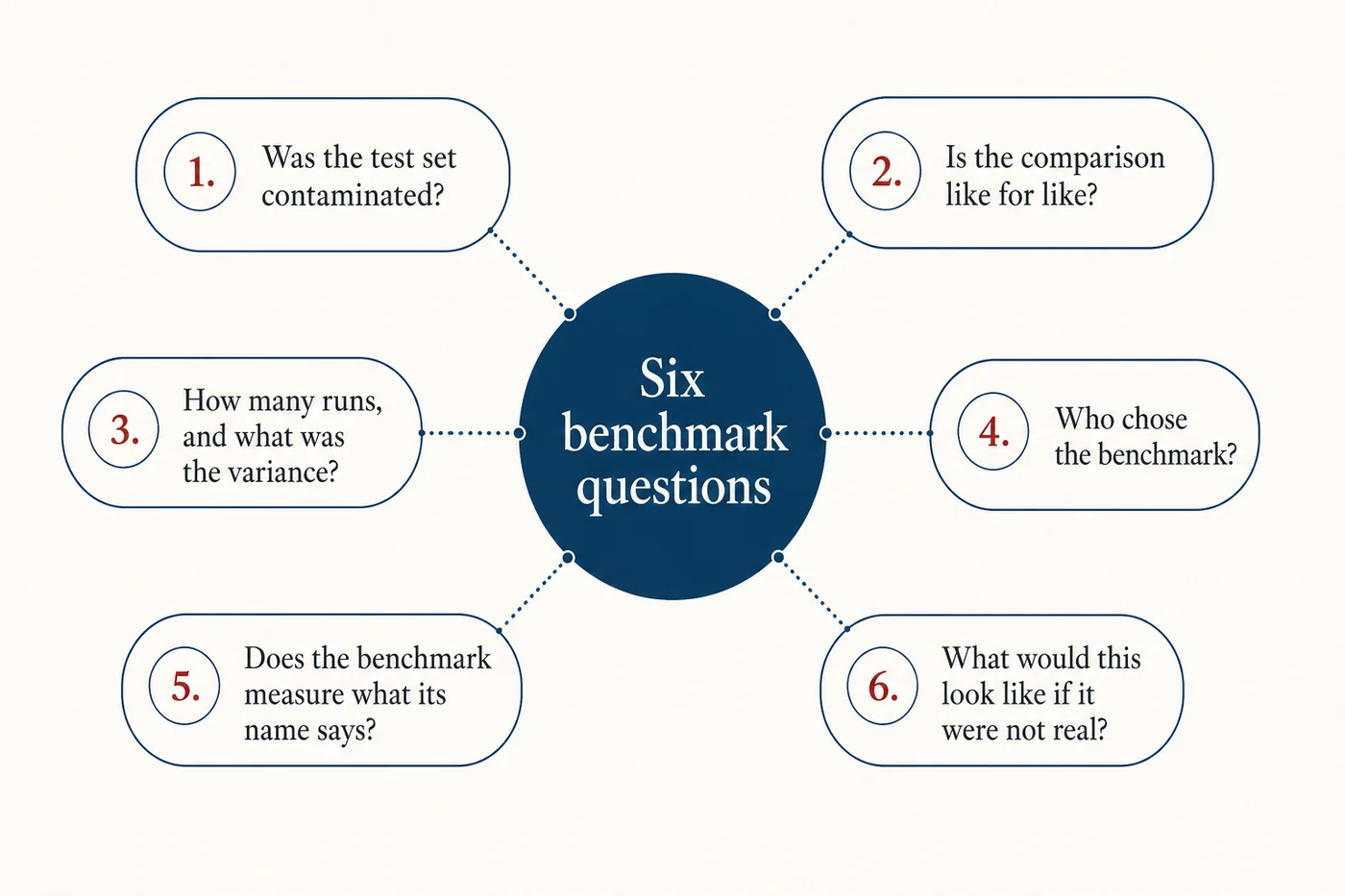
A lab posts a number. The number is higher than the previous number. Coverage follows. The useful question is not whether the score rose. It is what changed to make the score rise and whether the test supports the conclusion attached to it.
You can answer that in about ninety seconds with six questions. They do not require machine-learning expertise. They require reading the evaluation as a measurement instrument rather than a sports table.
Inside this guide
- First, define the claim being made
- Question 1: Was the test set contaminated?
- Question 2: Is the comparison like for like?
- Question 3: How stable is the result?
- Question 4: Who chose the benchmark and the presentation?
- Question 5: Does the benchmark measure what its name suggests?
- Question 6: What would a false positive look like?
- A worked reading pattern
- The six-question card
- Source trail
Continue reading
Unlock the remaining 10 sections for free, and get the twice-weekly briefing.